For the Placard
Seven artists at the Contemporary Art Museum Kumamoto explore how personal experience can become a public voice. The exhibition begins with Mitsuko Tabe’s 1961 essay and work Placard, then connects her challenge to social inequality with six artists working through photographs, moving images, installations and small sculptural objects.
Travel action
Open the route before you go
Use Google Maps as the final navigation check. Event areas, crowd controls, and station exits can change on the day.Event area
Check the venue or main event area and save it before leaving your hotel.
Nearest station
Check the station-side approach and keep one backup return route.
Photos
Photos and place context
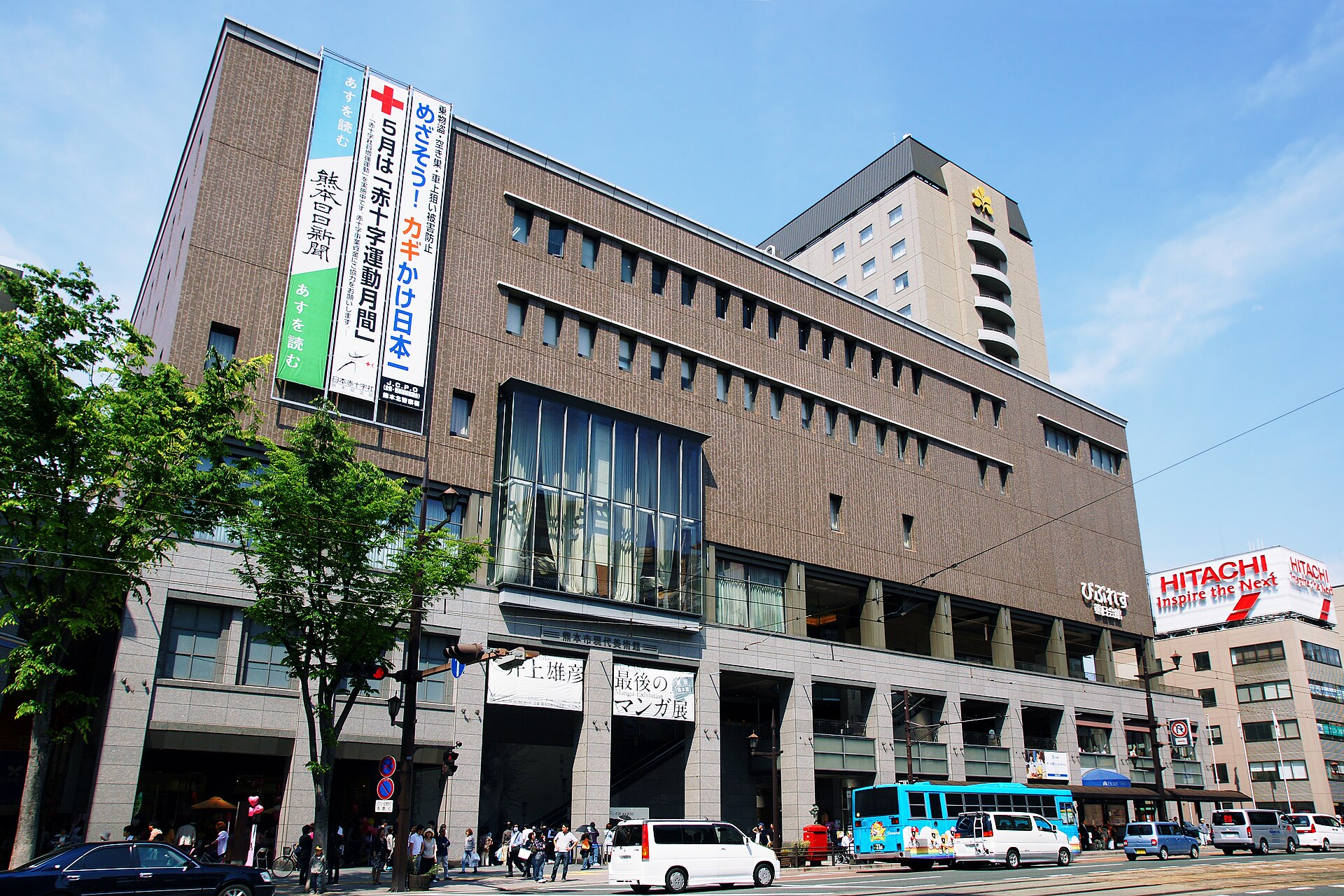
The Bipuresu Kumanichi Kaikan building housing Contemporary Art Museum Kumamoto, photographed on 2 May 2009. The old exhibition banners belong to that period, not to For the Placard. Photo title: “Bipuresu kumanichi-kaikan01s3200.jpg”. Wikimedia Commons resized this version; no further edits.
Photo: 663highlandsourceCC BY-SA 3.0
Visitor verdict
The exhibition gives Tabe’s ideas a substantial presence through 26 of her works. Her five-part Placard uses collage and kiss marks on sliding-door panels, making the choice of materials part of its challenge to established forms. Artificial Placenta grew from her experience of pregnancy and women’s inequality; the museum holds the 2004 recreation, since the 1961 original no longer survives. These works provide a starting point for asking how an experience that is difficult to express can take a visible form. The six other artists approach that question in distinct ways. Tomoko Ushijima combines words on irregular washi with an installation rooted in daily life and making. Lieko Shiga presents the re-edited video installation 風の吹くとき (2022–2025) and two photographs, drawing on her experience of the 2011 disaster and reconstruction. Shingo Kanagawa’s ongoing projects 祈り/長崎 and 明るくていい部屋 reconsider family and faith through his own life and body. Look closely at scale and materials: Sawako Tanizawa’s tiny ceramic-paper placards give form to voices that history has suppressed, while her cut-paper works enter into dialogue with earlier women artists. Yuki Iiyama’s film 海の観音さまに会いにいく follows a family trying to engage with the hallucinations experienced by her sister. Yuriko Sasaoka’s new 2026 Working Pig turns an old stuffed toy into a singing pig that asks its human audience about labour. Together, the works invite attention to how an image is made and who gets to speak, as well as to the subjects depicted.
Visitor friendliness
5 means easier and more rewarding for first-time visitors.
- Language friendliness
- Not scored
- Reservation ease
- Not scored
- Transport ease
- Not scored
- Crowd comfort
- Not scored
- Rain resilience
- Not scored
Practical information
- Reservation
- Not confirmed
- Tickets / booking
- Ordinary exhibition admission is ¥1,300 for adults, ¥1,000 for visitors aged 65 or older, and ¥800 for high-school-and-above students. Junior-high pupils and younger children enter free. Holders of eligible disability certificates and one accompanying person enter free, as do Welcome Passport holders with the required document. Groups of 20 or more and holders of specified tram or bus day passes may qualify for reductions; check the museum’s exhibition page for the applicable conditions. Tickets are handled by CAMK. The paid exhibition is in Galleries I and II. The Home Gallery talks and screening below are separate, free programmes with their own capacity and same-day arrival-order conditions. They do not run continuously with the exhibition, and an exhibition ticket does not reserve a programme seat.
- Price note
- Ordinary admission: adults ¥1,300; ages 65+ ¥1,000; high-school-and-above students ¥800; junior-high pupils and younger free. Proof-based exemptions apply. The separate Home Gallery programmes listed here are free and capacity-limited.
- Access
- CAMK is on the third floor of Bipuresu Kumanichi Kaikan, 2-3 Kamitoricho, Chuo-ku, Kumamoto. From Torichosuji tram or bus stop, the museum gives a one-minute walk to the entrance; use the escalator or elevator from the tram-street side. Parking in the building is limited, so the museum recommends public transport. Head to Galleries I and II for the exhibition, or the Home Gallery for the separately scheduled programmes.
- Rain
- The exhibition is indoors, making it a practical option when rain limits outdoor sightseeing. Allow for the short approach from Torichosuji and check transport conditions before travelling in severe weather; an indoor venue does not establish that services or opening arrangements will remain unchanged.
- Crowds
- The opening artist talk is on 19 September, 13:30–15:30, with 90 places in the Home Gallery, free and first come on the day. Six participating artists and curator Satoko Shoji are scheduled to take part; Lieko Shiga plans to join online. On 20 September, Yuki Iiyama’s In-Mates screening and after-talk runs 11:00–12:00, with 70 free places, first come on the day. The film lasts 26 minutes 50 seconds; visitors are asked to avoid entering or leaving during it. That afternoon, 14:00–15:30, Satoko Shoji gives the commemorative lecture, with 90 free places under the same arrival-order system. Both take place in the Home Gallery. Later In-Mates screenings are planned during the run; consult CAMK’s related-events page for dates instead of assuming the film is always showing in the galleries.
Recommended for
Visitors interested in contemporary Japanese art, women’s artistic histories, photography and moving-image work. It rewards a reflective visit in which you compare how different artists make everyday experience visible, rather than reading each work as an isolated statement.
Not recommended for
This may feel demanding if you want a quick, light visual stop: family relationships, psychiatric experience, inequality and labour are central themes, and several works use moving images or language. English subtitles or interpretation are not specified in the programme information; ask CAMK about language support if that will determine your visit.
Nearby / itinerary
- Nearby spots
- The Kamitoricho address and Torichosuji stop make it easy to keep the museum and a meal in central Kumamoto in the same part of your day. An evening visit can follow daytime sightseeing, but leave time to watch the moving-image works before the 20:00 closing rather than arriving at the 19:30 admission cutoff.
- Itinerary hint
- First check the exhibition calendar: it runs from 19 September to 29 November, normally closing on Tuesdays. It opens on Tuesday 22 September and Tuesday 3 November, with extra closures on 24 September and 4 November. Choose a normal gallery visit or build around one of the separate programmes; for a limited-capacity session, arrive before its start and keep time for the paid exhibition outside the session. The official CAMK exhibition page and press release explain the artists and works; the individual talk, screening and lecture pages confirm participation conditions. Use the visitor and access pages for museum arrangements, and check your return tram or bus service separately.
Source and updates
- Official URL
- https://www.camk.jp/exhibition/placard/
- Primary source
- Contemporary Art Museum Kumamoto (CAMK)
- Event verified
- Sep 18, 2026
- Source checked
- Sep 18, 2026
Details can change after publication. Always confirm dates, tickets, access, and cancellation notices with the official source before you go.